 PACKAGING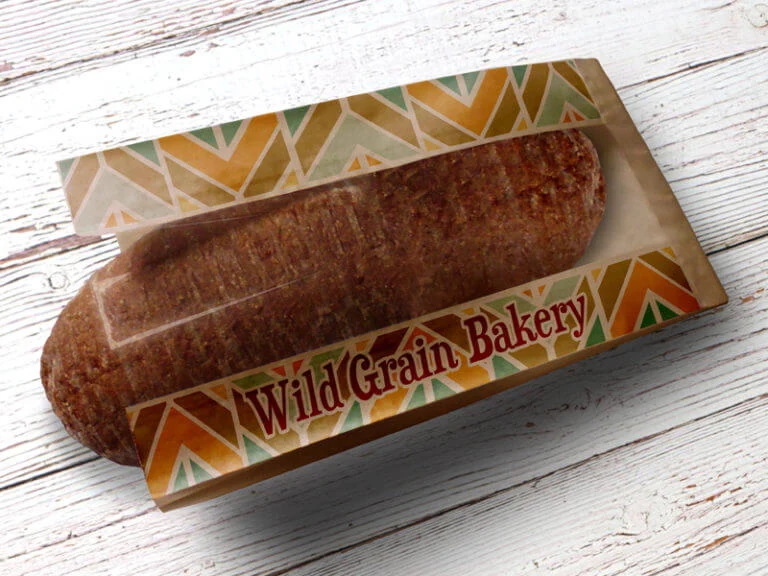
Selecting a paper bag is not the same as choosing the nearest catalogue size. The product should be measured first, including its maximum dimensions and the way it is placed into the bag.
Why the correct dimensions matter
A bag that is too small slows down packing and may tear when the product is inserted. A bag that is too large uses more paper, costs more and allows the product to move inside. At high volumes, a few unnecessary millimetres become a significant material difference.
Is a larger bag always safer?
No. A safe format provides the clearance needed for efficient packing without creating excessive empty space.
V-bottom bag construction
A complete specification includes bag width, bag height and the depth of each side gusset. The closed V-bottom forms naturally during production and is designed for lightweight bakery, confectionery and dry-food products.
- Width — the front face of the bag.
- Height — the usable length from the opening to the bottom area.
- Side gusset — the fold that increases the internal volume.
How to measure the product
Measure the product at its widest, highest and deepest points. Use the maximum real dimensions, not an average. For irregular bakery products, measure several pieces from normal production.
Send a photograph with a ruler or, for a new format, a physical sample. It often prevents mistakes that are difficult to see from dimensions alone.
Selecting bag width
Bag width must accommodate the visible front face of the product and part of its depth. Side gussets provide volume, but they do not replace adequate front width. The required allowance depends on whether packing is manual or automated.
Selecting bag height
Height should cover the product and leave enough free material for handling, closing or folding. The required top allowance depends on the product and the customer’s packing routine.
Selecting side gussets
The side gusset should reflect the product depth. Gussets that are too shallow make insertion difficult. Excessive gussets add paper and may create an untidy appearance after packing.
How the bag determines paper web width
For production, paper web width is calculated from the bag width, both side gussets and the longitudinal seam allowance. This is why every millimetre in the finished bag affects material consumption.
Practical rule
Finished dimensions describe the bag. Production dimensions describe the paper needed to manufacture it. Both must be considered when preparing a quotation.
Common specification errors
- Providing only one product dimension.
- Measuring the product before it reaches its final shape or temperature.
- Copying dimensions from another supplier without checking how they were defined.
- Adding a very large safety allowance “just in case”.
- Not stating whether the bag needs printing or an OPP window.
FAQ
What information is needed for a quotation?
Bag width, height, side gussets, kraft colour, plain/printed/windowed option and total quantity.
Can IPAK help determine the format?
Yes. Send the product dimensions, photographs and information about the packing method. For non-standard products, a sample is recommended.
Are printed and windowed bags available?
Yes. We manufacture plain bags, flexographically printed bags in up to four colours, and bags with an OPP window.
The best bag is not the largest one. It is the format that allows efficient packing, protects the product and avoids unnecessary paper consumption.
Need a quotation for V-bottom paper bags?
Send the dimensions, option, print requirements and planned quantity.
Request a quote →